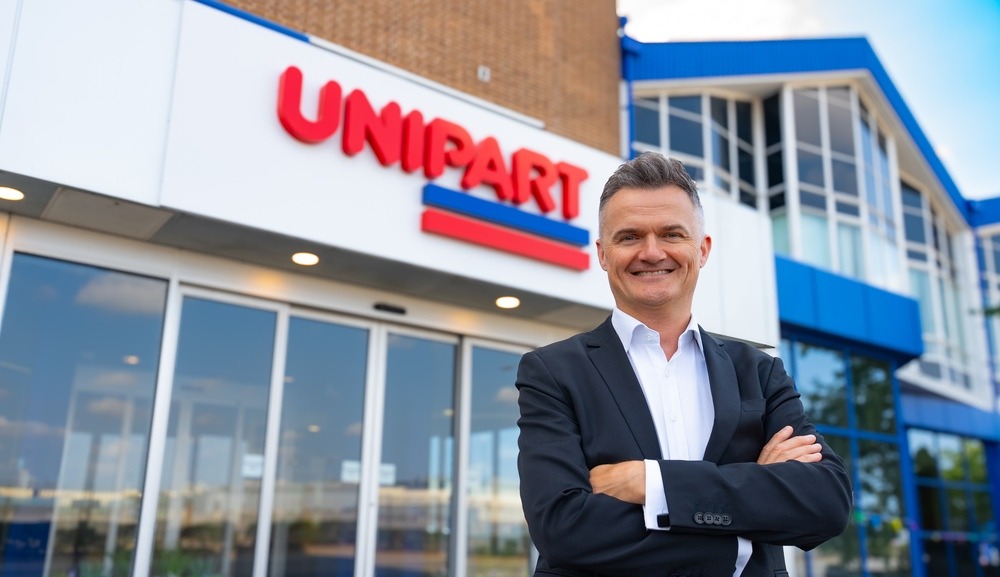
Linda Walmsley is a professional interviewer and business owner of UK recruitment search and selection firm, Walmsley Wilkinson Associates. During 2026 she is continuing to undertake a series of interviews with Business Leaders who have innovated within their field of expertise and have warranted the description of being an inspiring leader. Our latest Inspiring Leaders interview features Darren Leigh, Group CEO of Unipart, who shares his remarkable career journey from a 16-year-old YTS trainee to leading one of the UK’s most respected engineering, manufacturing and supply chain businesses. His reflections on leadership, culture, talent and continuous improvement provide valuable lessons for anyone leading people or building a career.
Profile – Darren Leigh, CEO, Unipart
Darren joined Unipart in April 2020 as Chief Financial Officer and was appointed Chief Executive Officer in October 2022.
Darren joined Unipart with over 30 years of experience in financial leadership and general management roles. Prior to joining, Darren held a number of senior finance positions at several blue-chip and private equity backed companies – including Finastra Limited, The Sage Group plc, Freightliner Group Limited, Inchcape plc, Marconi plc and Rolls-Royce plc. He has extensive knowledge across multiple sectors, including software and technology, logistics and supply chain, automotive, rail and manufacturing.
Throughout his career, Darren has delivered successful business turnarounds and growth, implementing and embedding corporate governance, leading global financial transformations and developing leadership teams to generate significant value. He has managed several business restructures, business mergers, acquisitions, integrations and disposals.
Darren’s commitment to The Unipart Way, Unipart’s unique culture which creates exceptional levels of employee engagement through empowering colleagues to continuously improve, combined with his unwavering focus on delivering value for Unipart’s stakeholders, will ensure Unipart continues to grow, winning new customers, in new geographies and market sectors.
He is a former Governor and member of the Finance Committee at Sandringham School.
Interview
What were your career aspirations when you were younger?
I would say that I’ve always been highly driven. From the very start, at a really young age, I knew that I wanted to have a career in business.
Thinking back to my school days, the overwhelming memory I have is that I just wanted to get going – to leave school and start work. I grew up in a working-class home in an old mining market town in Ilkeston, Derbyshire and did OK at school, but I honestly just wanted to get out into the world and start working. I wouldn’t say that I had a grand master plan, other than I just knew that my career was going to be in business.
It was a difficult time towards the end of my school years, the late ‘80’s, as there was a lot of unemployment, but I was really fortunate that as a school leaver I was offered five jobs. The one that stood out for me was the one that provided me with what I would now describe as a structured learning programme, in a real-world business environment. I worked across different parts of the business, and the company also gave me the opportunity to continue studying.
What was your first job?
I left school at 16 and I took up a YTS (Youth Training Scheme). This UK funded government scheme was only around for a couple of years. I think I must have been in the first cohort when I joined a local manufacturing company called Charnos. It was quite a humble beginning, but it provided me with what I was looking for, that structured learning, in a real-world environment; it also gave me some real, solid business foundations.
The first month that I was there, although I had started my new job, I was allowed time off to go back to school to finish my GCSEs. I started my professional career by doing entry level tasks. I did the filing, answered the telephone, and I guess I learned the most important skill of all, which was making tea for everybody in the office!
I recognise I was really fortunate. I worked hard. I tried to demonstrate that I could add value. And then a week before my 17th birthday, I was given the opportunity to take over what was called the Purchase Ledger department; we call it Accounts Payable today.
So just before I turned into an adult, I was a manager of four people; I became a manager before I became a man. That opportunity was a real catalyst for me developing my passion for leadership and business.
Charnos was a massive company at the time – it was a titan of high street hosiery and lingerie. There were 3 factories on one site and each of them had about 500 machinists. I used to have to walk through the factory in my shiny silver suit aged 16 and find paperwork such as orders and invoices and get them signed – let’s just say hundreds of machinists helped with my character building.
Who or what has inspired you in your life and career?
I’ve been inspired by lots of people along the way and I’ve been very fortunate to work with some really generous mentors and coaches. The types of people and leaders that inspire me are those that can combine strategic vision coupled with disciplined execution.
My first manager and mentor was a guy called Derek Henshaw, who sadly is no longer with us. He gave me the guidance and support that I needed at 17 years old to feel confident in tackling fairly significant transformation challenges.
Then at Marconi, I worked with the CFO there, Steve Hare, who’s now the CEO of Sage PLC. He was a real inspiration for me because I was a budding CFO myself. He was a leader who inspired others and still does – someone that clearly articulates a vision about the future, and he’s excellent at leading teams on that journey.
I’m also inspired by people that I work with at Unipart, and I’m fortunate that I’ve been able to surround myself with amazing people to help drive the business forward.
I would say when thinking about the ‘what’ has inspired me, one of the reasons that I joined Unipart was due to its unique culture. We call it The Unipart Way. It’s unlike anything else that I’ve ever experienced in other companies. The fact that it even has a name is unique. It’s a framework by which we kind of guide our employees to think, work, and behave in a way that is empowering and allows them to deliver continuous improvement – for our customers, for the company, and for themselves. That inspired me to the extent that I took up the offer to join Unipart, and it was definitely the right thing to do.
What life lessons would you share with others?
There’s quite a few really. My time at Marconi taught me a lot about personal resilience. I experienced an entire economic cycle from the sort of exponential growth of the dot-com boom to a market crash within just a few years; that does result in developing and learning a lot about resilience.
I had a similar experience also at Inchcape through the Great Recession in 2008 and 2009. As a result, I had the satisfaction of leading a team through an entire strategic cycle and eventually leading the business to deliver peak operating margins, even after such an unprecedented collapse of the local markets.
I think the lessons for me through those experiences that I’d share with others are that
it’s really important to develop a clear strategy and to execute that strategy with focus and discipline. If you do that in the right way, no matter what the circumstances are, you can emerge the other side of those challenges as a business even leaner and stronger than you were before.
I would also say that one of the things that I’ve learned along the way is that alongside resilience, you need self-confidence. Warren Buffett describes it as ‘an internal locus of control’. That’s about being confident in your own ability to draw the right conclusions without relying on everybody else to guide you and tell you what to do.
I remember early in my career, a lot of people telling me that if I didn’t go to university full time, I’d hit a ceiling and I wouldn’t be able to go beyond a certain point. I’m really glad that I didn’t listen to them as I genuinely feel I made the right decision, leaving school and going straight to work. I think those are the valuable lessons that I’d share with others.
What five words best describe you?
It’s really hard to narrow down, but what I would say, first of all, is that I’m driven. Secondly, curious, and thirdly, strategic. And then if I could include a couple of hyphenated words, I would say hard-working and people-oriented.
As a business leader, I like to look beyond the P&L account and the balance sheet, to the people who make the numbers possible. That’s really important for me.
Do you have a favourite saying or quote?
I’ve previously quoted Warren Buffett in terms of how important it is to have an internal locus of control. Probably that’s the one that stands out to me.
Which technologies excite you the most, and why?
I’m excited by technology that helps to scale human potential and improve performance, not just technology for technology’s sake.
Obviously, AI is the technology that everybody’s talking about at the moment, and I do believe that AI has the potential to do that if it’s used in the right way. I’m currently particularly focused on how we leverage innovation and automation and AI to drive continuous improvement for our business and for our customers, but in conjunction with people.
What we do at Unipart, is that we use the principles of The Unipart Way that allows us to constantly evaluate and elevate our own technologies, ensuring that our processes and our systems evolve through the same sort of rigorous problem solving and employee led innovation, means that we also apply it to contracts and physical operations. I think where AI can play a role in that, we’re looking to deploy it and make best use of it in that way. It’s all about scaling human potential really, particularly at Unipart.
How should the Human Resources function operate within any business?
I think I must come back to the topic of culture. For me, culture and performance are inseparable.
If we consider The Unipart Way, I would describe that as our greatest asset. It’s an intangible asset, but it’s still our greatest asset. It’s been developed and nurtured and embedded over nearly four decades to empower all of our people to continuously improve and to harness the talent that they have.
In that timeframe and through the whole process, HR has had a really key role in establishing and maintaining this culture and this ecosystem, focusing on both people and performance to ensure that our people are empowered and that they’re thinking about and solving problems for their customers.
At Unipart, we call HR our People function, as it provides leadership and it provides support across our business to enable managers and all of our talent to develop, perform, grow and to deliver Unipart’s growth strategy, which we call “The Unipart Way Forward”.
At Unipart, I spend just as much time, if not more time, with my Chief People Officer as I do with my Chief Financial Officer. So that should tell you something about what I think the role of HR plays within Unipart.
What are your views on attracting talent and retaining people?
Of course, people are the lifeblood of any business so retaining and attracting talent is always going to be key to our growth and our future success. We see a key measure of this being employee engagement and place a lot of focus on ensuring that our colleagues are engaged and that they feel safe and supported by everybody at Unipart. In 2025, we achieved record employee engagement levels and results which are deemed in the upper quartile of all businesses.
Our people are also three times more actively engaged than the average UK company. We have and will continue to invest in the skills and workforce development – including entry level skills programmes, apprenticeships and graduate schemes. We offer initiatives such as the Big Charity Challenge, where we encourage our people to get involved in fundraising and volunteering for the community, for initiatives they most care about. We give our people opportunities to move around different departments, to experience different ways of working and different types of roles within the company. We have a 25-year club, which is an annual get together of employees and ex-employees who have at least 25 years of continuous service with the company. Can you believe that we have over 900 active members of the 25-year club? I think that just shows you how important employee engagement is and what it means to not only Unipart, but Unipart’s employees and past employees as well.
I talked earlier about our Chief People Officer, Vicky Hooper, who is a really good example of this. She originally joined Unipart as a graduate a long time ago, and she’s worked her way up to an executive position and is a senior leader, now leading the People function. Her role, experience and leadership is incredibly valuable.
Has workplace diversity and inclusion now become embedded at Unipart or is there still much more to do?
The UK has come a long, long way in the last 30 to 40 years. I would also recognise though there’s still a lot more that we can do, particularly regarding social mobility. I do feel strongly about how I can influence this both inside and out of Unipart. I feel strongly that business and government must do more to tap into the rich array of talent that exists across all backgrounds.
Given my background, I’m a big believer in the fact that your starting point in life shouldn’t limit your potential. I came from a working-class background, I didn’t get fantastic grades at school, and I started out on a YTS, but then I’ve managed to grow through to the role of CEO. It is a really good example of what is possible. And I think that when you think about the roles of business, industry and government, industry has a role and a responsibility to create jobs and ensure that the doors are open for graduates, for apprentices, for people that are looking for work. I also think the government has a responsibility to help and encourage people to go through those doors.
I believe there’s a lot more that we can do on both fronts there.
What legislation would you amend or implement to support UK business?
There are several pieces of legislation I feel strongly about and would implement. For me, I’d be keen to push for support in bridging the gap between education and the workplace, whilst at the same time managing the rising cost of labour. It’s a challenge for industry at the moment that we have, particularly in the UK. So where would I start?
There’s lots of areas I would tackle. I think I’d start with the apprenticeship levy as the system we have is too rigid. Therefore, we’ve seen apprenticeships drop by about a third over the last decade. That is not a good trend. I would push for a levy that lets us use the money differently, use it for shorter, more flexible training programmes that actually match modern ways of working and the way that businesses are evolving. Business has to take a risk on unproven hires and unproven people when they’re looking to recruit entry level jobs. With the cost of entry level jobs going up, it becomes a much harder business case for a manager to justify hiring somebody who has effectively zero experience. That’s really challenging.
I’d also seek legislation that gives some kind of national insurance rates or incentives for hiring from that pool of around a million people that we have sitting on the sidelines. We need a welfare system that actually coaches people back into work; the current system isn’t working. We’ve got young people who are signed off sick, sometimes with mental health issues, and they’re just drifting further and further away from the job market. What we’ve got to do is coach them back into the workplace. And I think we would also benefit from bringing business studies or work readiness training back into the classroom.
With the decline that we’ve seen in the last few decades in Saturday jobs, many young people are going into the workplace without even the basic understanding of the rhythm of a working day; COVID and hybrid working have exacerbated that problem even more. We’ve got to do more to get people, children, teenagers ready for the work environment.
What advice would you give to any individual who is keen to develop a career in business?
I would advise people to go for it. What I would also say is that a career is for life. So you have to be prepared for the long term.
I would also advise them from day one to approach it in a very curious way and never stop being curious, never stop learning. I would say that you have to work really hard to understand yourself and you must also work hard to understand exactly what the company expects from you so that you can meet their expectations and actually exceed those expectations. That’s what managers and companies really want. They want people to come in, knowing what’s needed of them and then exceed those expectations.
I’d advise people to embrace real life situations, even difficult ones, because that’s where you actually learn as an individual and it’s where your leadership style is forged in those times of adversity. And based on my own career, I would say don’t be afraid of taking on what you might think of as boring or mundane tasks initially, because that’s where you learn. I took to Accounts Receivable like a duck to water, and I really enjoyed the “boring” jobs of opening the post, chasing invoices, reconciling cash, all those sorts of things.
My advice would be based on the fact that my own career was forged through a lot of hard work but also having some great mentors and being in a position to take advantage of luck when it came along. I would advise people to be ready, be prepared for when those moments of luck come along and then you’re there and ready to take advantage of them.
In your opinion what elements are key to being a successful CEO?
First, as a CEO, you have to understand that you’re there to create value. That’s the primary role of the CEO.
Secondly, a CEO must consider and lead the business in the best interest of all stakeholders. So, in Unipart’s case for me, that applies to our 8,500 employees, our 7,000 pensioners, our 8,000 customers and our 4,000 shareholders. It’s really important as CEO that you recognise that you are there to create value for all of them. If you narrow your perspective too much on one stakeholder or another, you do it at the expense of the others. You have to think about all of them because to be successful, all stakeholders need to feel like they’re getting value from the company and they’re getting value from the CEO.
You’ve also got to be able to navigate challenges, global crises, things like COVID, global recessions, raw material shortages, global supply chain disruptions like the Suez Canal blockage that we had a few years ago. All those things disrupt supply chains and the way that businesses operate. You must be able, as a CEO, to navigate through those things. You must be agile; you must work hand in hand with an experienced team of people. Going back to something I said earlier, which is essential, you’ve got to be able to develop and execute a clear strategy in all circumstances.
If you can do all that, you can be a CEO.
What is your biggest career highlight or achievement to date?
It’s been a long career so far. That’s probably my biggest achievement!
There have been a few highlights, and I would say most of those highlights were born out of a crisis or an adversity. For example, leading the Baltic region of Inchcape through the Great Recession of 2008 and 2009 was a really proud moment for me. It was a really difficult time with tough decisions having to be made but taking a business through a restructuring that was as hard as that and then coming out the other side of it to then deliver peak operating margins for that part of the business, that was incredibly rewarding and satisfying.
I’m also proud of the disciplined leadership that we showed as a team during the successful sale of the Freightliner business when I was there as CFO.
More recently, probably one of the biggest highlights I’ve had at Unipart was in my first full year as CEO in 2023 where turnover broke through the one-billion-pound barrier for the first time. We almost doubled our profits during that first year of our new strategy, The Unipart Way Forward. I feel incredibly lucky and privileged to have had the career that I’ve had so far, and there have been lots of highlights for me.
How do you like to spend your time outside of work?
I don’t have a lot, but any time I do have, I like to spend with my family. I love time with my wife and my three daughters, and all of my daughters at present are, or are very nearly, embarking on their own career journeys, so I get to talk to them about that. I love to travel with them. I recently came back from a trip to Japan with my wife and some friends. It was great to see the unique culture that was evident in Japan compared to the UK. There was a great blend of ancient traditions and modern evolution and innovation.
What I saw there was a society focused on respect, order and continuous improvement. Those are the foundations of The Unipart Way, which is effectively based on the Toyota Production System, which sort of came out of that culture. Experiencing that firsthand, made me feel incredibly proud of Unipart and our history.
What’s next for you and Unipart?
We’ve got a clear strategy for the business and we’re continuing to focus on delivering growth in line with that strategy. We get to work and grow with some really amazing global brands. We have a pipeline of opportunities to work with a lot more companies solving their supply chain needs and demands. Supply chains have never been more complex, so I believe Unipart is really in a unique position.
We’ve got a breadth of solutions, whether it’s consultancy, manufacturing, warehousing solutions, transport solutions, and performance improvement solutions. We have a great portfolio that can help customers save time, cost and carbon.
We’re in a great position to do that as Unipart is a unique business. It’s unique in terms of what it offers to colleagues that come and work for us and it’s unique in terms of what it offers to customers. I guess one of my missions is to help as many people understand that as possible. So, I think that’s what’s next for Unipart.
And as for me, I’m 38 years into my career journey and I’m only just getting started. I’ve got a lot more life left in me yet!